
GoHighLevel vs Salesforce: Which CRM Is Better in 2026?
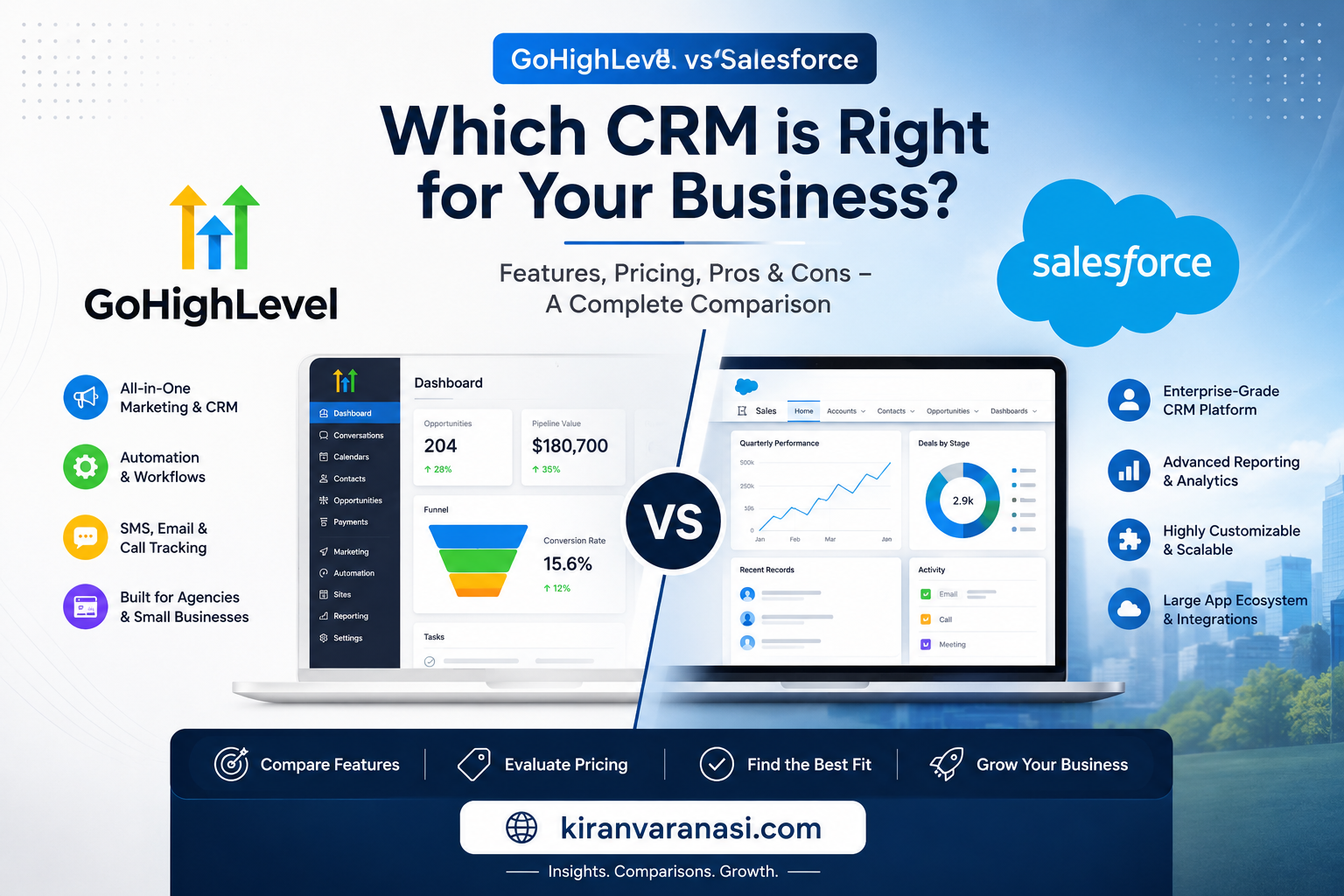
Businesses today don’t suffer from a lack of CRM software choices. The real challenge is choosing a platform that helps the team generate leads, manage customer relationships, automate follow-up and close more business without creating unnecessary complexity.
When comparing GoHighLevel vs Salesforce, it is important to understand that these platforms are designed around different priorities.
GoHighLevel focuses heavily on lead generation, marketing automation, communication and conversion, while Salesforce provides a deeper CRM ecosystem designed for organizations that need extensive customization, sales management, reporting and enterprise-level control.
That means the right choice depends less on which platform has more features and more on which platform fits the way your business actually operates.
GoHighLevel vs Salesforce: Which CRM Is Better in 2026?
There is no universal winner between GoHighLevel and Salesforce.
GoHighLevel is generally more attractive for agencies, consultants, coaches, local businesses and service companies that want CRM, funnels, communication, appointment booking and automation connected in one platform.
Salesforce is generally stronger for organizations with complex sales operations, large teams, advanced data requirements, extensive customization and enterprise-level governance.
The key question is simple:
Do you need an all-in-one growth platform or a highly customizable enterprise CRM?
What Is GoHighLevel?
GoHighLevel is an all-in-one platform designed around customer acquisition and business growth.
It brings together tools for CRM, lead capture, websites and funnels, appointment scheduling, communication, automation, reputation management and other marketing functions.
Its official platform positioning emphasizes a workflow that helps businesses capture, nurture, close, retain and reactivate customers.
This makes GoHighLevel particularly relevant to businesses that want to reduce the number of separate tools involved in their marketing and sales process.
What Is Salesforce?
Salesforce is a broad CRM platform designed to manage customer relationships and sales operations across organizations of different sizes.
Its current CRM and Sales Cloud offerings include lead, account, contact and opportunity management, sales flows, forecasting, reporting, automation and customization.
Salesforce becomes especially valuable when a business requires a sophisticated CRM structure rather than simply a tool for managing leads and follow-up.
GoHighLevel vs Salesforce: Platform Philosophy
One of the biggest differences between the two platforms is their underlying philosophy.
GoHighLevel is growth and conversion focused.
The platform is designed to help businesses attract leads, communicate with prospects, automate repetitive tasks and move opportunities toward conversion.
Salesforce is CRM and organizational-process focused.
It is designed to give businesses extensive control over customer data, sales processes, reporting, permissions, customization and integrations.
This distinction matters because more features do not automatically mean a better platform.
The better platform is the one that solves your actual operational problem.
GoHighLevel vs Salesforce Pricing
Pricing should not be evaluated by subscription price alone.
You should also consider:
- Number of users
- Required features
- Add-ons
- Integrations
- Implementation
- Administration
- Training
- Ongoing maintenance
- Technical support
Salesforce currently offers CRM plans including Free, Starter, Pro, Enterprise and Unlimited options. Its published Sales Cloud pricing includes Starter at $25 per user/month, Pro at $100, Enterprise at $175 and Unlimited at $350, with pricing subject to change and additional products or add-ons potentially costing extra.
GoHighLevel uses a different pricing approach, with plans positioned around businesses and agencies rather than simply charging for every CRM user.
The practical difference is important:
A lower subscription price does not always mean a lower total cost, and a more expensive CRM does not always provide better value for a smaller business.
GoHighLevel vs Salesforce Feature Comparison
| Feature | GoHighLevel | Salesforce |
|---|---|---|
| CRM | Strong | Very strong |
| Lead management | Strong | Very strong |
| Sales pipelines | Strong | Very strong |
| Marketing automation | Strong | Strong |
| Email automation | Strong | Strong |
| SMS communication | Strong | Available through relevant products/integrations |
| Funnels | Strong | Requires additional solutions |
| Appointment booking | Strong | Available through Salesforce ecosystem |
| Reporting | Good for common business needs | Advanced |
| Customization | Good | Excellent |
| Enterprise governance | Limited compared with Salesforce | Excellent |
| Agency management | Strong | Not the primary focus |
| Ease of setup | Generally simpler | More configuration may be required |
| Complex data models | More limited | Strong |
| Large enterprise operations | Less suitable | Strong |
The difference is therefore not simply feature vs feature.
It is simplicity and growth workflows vs depth and customization.
GoHighLevel Automation Engine
Automation is one of GoHighLevel’s strongest selling points.
Instead of requiring employees to manually move every prospect through the customer journey, businesses can create workflows that respond to customer actions.
A typical process can look like this:
New Lead → Automated Response → Qualification → Appointment → Follow-Up → Sales Opportunity → Customer
For example, a business could:
- Respond automatically when a lead submits a form
- Send an SMS message
- Start an email sequence
- Move the lead through a pipeline
- Schedule an appointment
- Trigger reminders
- Request a review after service
- Reactivate older leads
The objective is simple:
Reduce manual work while improving response speed and consistency.
Salesforce Automation Capabilities
Salesforce also provides powerful automation capabilities, but the platform is designed for a broader range of business processes.
Its current Sales Cloud plans include capabilities such as sales flows, lead routing, forecasting, automation and customization, with more advanced functionality available at higher tiers.
This makes Salesforce particularly useful when automation needs to involve complex business rules, multiple departments, detailed customer records or sophisticated approval processes.
The trade-off is that implementing this level of customization can require more planning and technical expertise.
GoHighLevel for Marketing Automation
GoHighLevel is particularly useful when marketing and sales activities need to operate together.
A typical workflow can be:
Ad → Landing Page → Lead Capture → SMS/Email → Qualification → Appointment → Sales Follow-Up
This reduces the need to connect multiple systems for basic lead-generation workflows.
For agencies and service businesses, this can be a major advantage because the marketing journey and sales pipeline can operate from the same environment.
Salesforce for Marketing and Sales Operations
Salesforce can support sophisticated marketing and sales operations, but its ecosystem is broader.
A business can build highly customized processes around customer information, sales stages, reporting, forecasting and integrations.
This is valuable when the organization has complex requirements.
However, smaller companies may not need that level of customization.
If the main objective is simply:
Generate leads → Follow up → Book appointments → Close customers
a simpler platform may be more practical.
GoHighLevel vs Salesforce for CRM
Both platforms can manage contacts, leads and sales opportunities.
The difference is depth.
GoHighLevel focuses on making the CRM useful as part of a broader marketing and conversion system.
Salesforce provides much deeper customization for organizations that need complex CRM architecture.
For example, an enterprise may need:
- Multiple sales teams
- Different sales processes
- Advanced permissions
- Complex account structures
- Custom objects
- Detailed reporting
- Advanced forecasting
- Multiple integrations
- Department-level workflows
This is where Salesforce becomes increasingly valuable.
Ease of Use and Implementation
Ease of implementation is often overlooked when comparing CRM platforms.
A CRM that has hundreds of features is not necessarily useful if your team struggles to configure or use it.
GoHighLevel generally appeals to businesses that want to get marketing and sales workflows running without building a highly customized enterprise CRM environment.
Salesforce can require more planning because organizations may need to configure:
- Data structures
- User permissions
- Sales processes
- Reports
- Automation
- Integrations
- Custom fields
- Governance
For a growing business, this distinction can have a significant impact on implementation time and internal resources.
GoHighLevel vs Salesforce for Small Businesses
For many small businesses, the main CRM requirements are relatively straightforward:
- Capture leads
- Track opportunities
- Follow up automatically
- Send emails and messages
- Book appointments
- Manage customers
- Measure conversions
GoHighLevel can be a strong fit when these activities need to operate together.
Salesforce can also serve small businesses, and its current CRM offering includes a Free Suite and Starter Suite aimed at smaller organizations.
The question is whether the business needs Salesforce’s broader CRM ecosystem or prefers an integrated growth platform.
GoHighLevel vs Salesforce for Agencies
This is one of the clearest areas where GoHighLevel can stand out.
Agencies often need to manage:
- Multiple clients
- Lead generation
- Funnels
- Marketing campaigns
- Appointment booking
- SMS and email
- Sales pipelines
- Automated follow-up
- Reputation management
GoHighLevel is designed with agency workflows in mind.
That makes it particularly attractive to marketing agencies and lead-generation businesses that want to provide multiple services through one platform.
Salesforce can certainly support agencies, but agency-focused marketing automation is not the primary reason organizations choose Salesforce.
GoHighLevel vs Salesforce for Enterprise Businesses
Enterprise businesses typically have more complex requirements.
They may need:
- Advanced forecasting
- Complex sales structures
- Custom data models
- Detailed permissions
- Multiple departments
- Enterprise integrations
- Advanced analytics
- Governance
- Large-scale administration
Salesforce is generally better suited to this environment.
Its higher Sales Cloud tiers provide more advanced pipeline management, deal insights, forecasting, automation, customization and enterprise functionality.
GoHighLevel can be powerful, but it is not primarily designed to replace a deeply customized enterprise CRM architecture.
GoHighLevel vs Salesforce for Lead Generation
If lead generation is central to your business model, GoHighLevel has a practical advantage.
You can build a connected process around:
Traffic → Funnel → Lead → Communication → Appointment → Pipeline → Conversion
This reduces the number of separate systems required for the customer acquisition process.
Salesforce can manage leads extremely well, but businesses may need additional products, configurations or integrations depending on how sophisticated the marketing workflow becomes.
GoHighLevel vs Salesforce for Sales Teams
Salesforce has a major advantage when the sales organization becomes complex.
A large sales team may require:
- Territory management
- Forecasting
- Deal tracking
- Sales reporting
- Account hierarchies
- Multiple pipelines
- Advanced permissions
- Sales performance analysis
Salesforce is designed to support these types of processes.
GoHighLevel is more compelling when the sales process is simpler and closely connected to marketing automation.
GoHighLevel vs Salesforce Integrations
Integrations are another important consideration.
The right question is not simply:
“How many integrations does the platform have?”
Instead ask:
“Can the platform connect reliably to the systems my business already uses?”
Consider your:
- Website
- Payment system
- Email platform
- Advertising platforms
- Accounting software
- Customer support tools
- Scheduling tools
- Data warehouse
- Internal applications
Salesforce has a broad ecosystem and extensive integration capabilities, while GoHighLevel focuses strongly on connecting the tools required for marketing, communication and customer acquisition.
GoHighLevel vs Salesforce Scalability
Both platforms can scale, but they scale in different ways.
GoHighLevel scales particularly well when the business model is based around repeatable customer acquisition and marketing workflows.
Salesforce scales particularly well when organizational complexity increases.
The distinction can be summarized as:
GoHighLevel = scale the growth process
Salesforce = scale the CRM operation
Pros and Cons of GoHighLevel
Advantages
- Strong all-in-one marketing and CRM approach
- Lead-generation focused
- Strong automation
- Email and SMS workflows
- Funnel capabilities
- Appointment management
- Attractive for agencies
- Useful for service businesses
- Reduces dependence on multiple disconnected tools
Limitations
- Less suited to highly complex enterprise CRM requirements
- Less extensive customization than Salesforce
- May require additional tools for specialized enterprise needs
- Advanced enterprise governance is not its primary focus
Pros and Cons of Salesforce
Advantages
- Powerful CRM capabilities
- Extensive customization
- Advanced reporting
- Strong sales management
- Sophisticated forecasting
- Large integration ecosystem
- Enterprise scalability
- Strong governance and permissions
- Suitable for complex organizations
Limitations
- Can require more configuration
- Implementation can be more complex
- Administration may require specialist knowledge
- Per-user pricing can become significant as teams grow
- Smaller businesses may not need all of its capabilities
Can GoHighLevel and Salesforce Work Together?
Yes, depending on the business requirements.
Some organizations may use Salesforce as the primary CRM while connecting specialized marketing or communication platforms around it.
However, adding another platform also creates additional responsibility.
You need to determine:
- Which platform owns customer data?
- Where are leads created?
- Where are opportunities managed?
- Which system triggers communication?
- How is data synchronized?
- What happens when information changes?
The goal should always be to maintain a single source of truth wherever possible.
Which Is Better: GoHighLevel or Salesforce?
The answer depends on the business.
Choose GoHighLevel when you want:
- Marketing automation
- Lead generation
- Funnels
- SMS and email follow-up
- Appointment booking
- CRM
- Sales pipelines
- An integrated growth platform
- Agency-focused workflows
Choose Salesforce when you need:
- Enterprise CRM
- Advanced customization
- Complex sales processes
- Detailed reporting
- Forecasting
- Complex permissions
- Large sales teams
- Extensive integrations
- Enterprise governance
GoHighLevel vs Salesforce: Final Verdict
GoHighLevel and Salesforce should not be viewed simply as two competing CRM products.
They represent two different approaches to managing customer relationships.
GoHighLevel is focused on helping businesses attract, nurture and convert customers through an integrated growth platform.
Salesforce is focused on providing a highly customizable CRM ecosystem capable of supporting complex sales and enterprise operations.
For an agency, consultant, coach, local business or growing service company, GoHighLevel may provide the better balance of functionality, automation and operational simplicity.
For a large organization with complex sales processes, multiple departments, advanced reporting and extensive CRM requirements, Salesforce is likely to be the stronger long-term choice.
The best CRM is not the one with the longest feature list.
It is the one your team can actually implement, use consistently and connect to the way your business generates revenue.