
GoHighLevel White Label Pricing 2026 Features and Cost
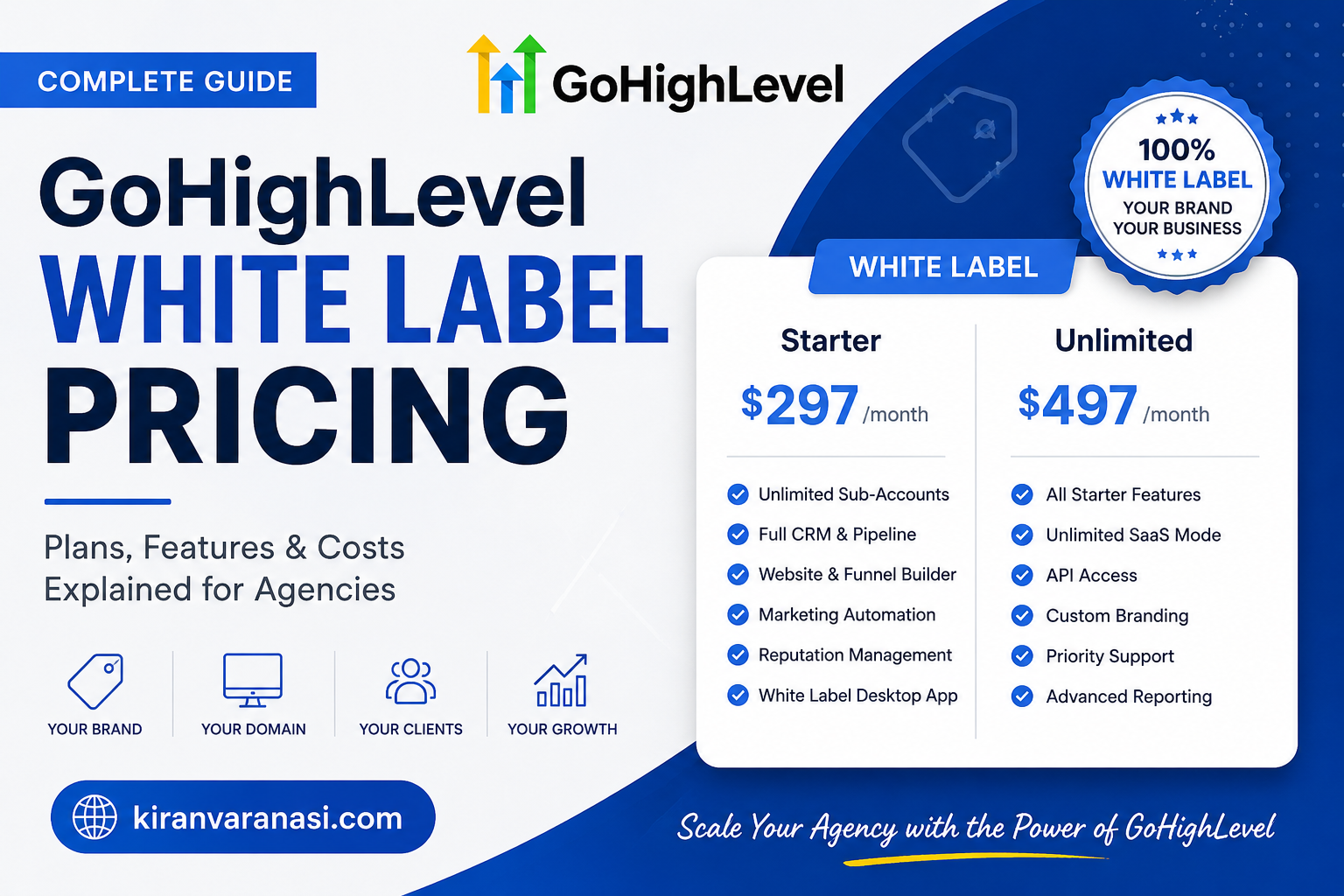
If you’re researching GoHighLevel white label pricing, chances are you’re not simply looking for another CRM. You’re looking for a way to create recurring revenue, strengthen your agency brand and offer clients a professional software experience without developing your own platform from scratch.
GoHighLevel white labeling allows agencies to present the platform under their own brand, giving clients a more customized experience. This can help agencies move beyond one-time service revenue and build software-based recurring revenue.
But the important question is not simply how much GoHighLevel costs.
The real question is:
Does the investment make sense for your agency and business model?
GoHighLevel White Label Pricing: What Agencies Need to Know
GoHighLevel white label pricing refers to the cost of using HighLevel’s platform while presenting the software under your own agency branding.
Instead of asking clients to log into a platform carrying another company’s identity, agencies can create a branded software experience that becomes part of their own service offering.
This creates an opportunity to position your agency as more than a service provider.
You can become a software-enabled service provider with a recurring revenue model.
What Is GoHighLevel White Label?
GoHighLevel white label allows agencies to customize the client-facing experience with their own branding.
The basic idea is straightforward:
HighLevel provides the technology. Your agency provides the brand, offer and customer relationship.
This can be particularly valuable for marketing agencies, consultants, coaches, lead-generation companies and other service businesses that already manage customer acquisition and communication for clients.
Instead of selling only services, you can package software access into your monthly offer.
Why Agencies Choose White-Label Software
One of the biggest challenges for agencies is creating predictable recurring revenue.
Service revenue can fluctuate. Clients may pause campaigns, reduce budgets or cancel projects when priorities change.
Software subscriptions can create another layer of recurring revenue.
When evaluating GoHighLevel white label pricing, you’re therefore not simply paying for software features.
You’re evaluating a business model.
The potential advantages include:
- Recurring monthly revenue
- Stronger client retention
- Higher customer lifetime value
- Greater brand authority
- Differentiation from competitors
- Software and service bundles
- A more scalable agency model
Instead of charging clients only for marketing services, agencies can combine services and software into a single monthly offer.
GoHighLevel White Label Pricing Plans
When researching GoHighLevel white label pricing, it is important to understand which plan provides the capabilities your agency actually needs.
HighLevel’s plans and features can change over time, so agencies should always verify the current pricing and included functionality before making a purchasing decision.
The key consideration is whether you need basic CRM functionality, agency-level account management or a broader SaaS-style business model.
GoHighLevel Unlimited Plan
The Unlimited plan is designed for agencies that need to manage multiple client accounts under an agency environment.
For agencies, the important value comes from being able to manage multiple accounts while building repeatable client workflows.
Depending on the current plan structure, agency-focused capabilities may include:
- Multiple client sub-accounts
- Agency dashboard
- Client account management
- Automation tools
- Agency-level controls
- Branded client experience
The more clients you manage, the more important centralized account management becomes.
GoHighLevel SaaS Pro Plan
For agencies that want to build a software subscription business, the SaaS-focused capabilities become particularly important.
SaaS functionality can allow agencies to package the platform into their own recurring software offers.
This can support:
- SaaS-style subscriptions
- Automated onboarding
- Client billing workflows
- Software packaging
- Recurring revenue
- Agency-level revenue management
For an agency that already has a reliable client acquisition process, this model can create an additional revenue stream.
Which GoHighLevel Plan Should You Choose?
The right plan depends on what you’re trying to build.
If you simply need CRM and marketing functionality for your own business, you may not need advanced white-label or SaaS capabilities.
If you’re managing multiple clients and want to provide a branded platform, an agency-level plan becomes more relevant.
If your goal is to sell software subscriptions under your own brand, you should evaluate the plan that currently includes the SaaS capabilities required for your business model.
Don’t choose a plan because it has the most features. Choose it because it supports the business model you want to build.
Features Included With GoHighLevel White Label
One of the major attractions of GoHighLevel is the number of business functions that can be brought together within one platform.
Depending on the plan and current product configuration, agencies can use capabilities such as:
- CRM
- Marketing automation
- Website building
- Funnel building
- Email marketing
- SMS communication
- Appointment scheduling
- Reputation management
- Sales pipelines
- Reporting
- Client account management
This software consolidation can be valuable because agencies don’t have to manage every function through a different platform.
CRM and Client Management
The built-in CRM allows businesses to organize contacts, track opportunities and manage sales pipelines.
For agencies, the benefit goes beyond simply storing contact information.
The CRM can become part of a repeatable system for managing leads, customers and client activity.
This allows agencies to create standardized processes instead of rebuilding their workflows for every client.
Marketing Automation
Automation is one of the strongest reasons agencies consider GoHighLevel.
Businesses can create workflows for tasks such as:
- Lead nurturing
- Appointment reminders
- Follow-up messages
- Email sequences
- Customer onboarding
- Review requests
- Lead reactivation
A typical automated workflow might look like:
New Lead → Automated Response → Nurture → Appointment → Follow-Up → Conversion
The goal is simple:
Reduce manual work while improving response speed and consistency.
Website and Funnel Builder
A website and funnel builder can help agencies create landing pages, lead-generation pages, sales funnels and other conversion-focused assets.
This is particularly useful when the agency wants to keep the marketing technology stack inside one platform.
Instead of paying for separate systems for every function, agencies can consolidate more of their workflow under their branded environment.
SMS and Email Communication
Communication is an important part of lead conversion.
A prospect who submits a form today may not be ready to buy immediately.
Automated email and SMS follow-up allows businesses to continue the conversation without requiring someone on the team to manually contact every lead.
This becomes particularly valuable when an agency manages a large number of leads across multiple client accounts.
Appointment Scheduling
Appointment scheduling can connect lead generation directly to the sales process.
A common workflow is:
Lead Captured → Follow-Up → Calendar Booking → Reminder → Sales Call
This reduces friction between marketing and sales.
Instead of sending prospects to several different systems, the process can be designed around one connected customer journey.
Reputation Management
For local businesses, online reviews can have a major impact on customer trust.
Automated review-request workflows can help businesses consistently ask satisfied customers for feedback after a transaction or service.
For agencies managing reputation campaigns, having this functionality within the same platform can make the service easier to package and manage.
Is GoHighLevel White Label Pricing Worth It?
This is probably the most important question.
The answer depends on whether your agency can turn the platform into measurable business value.
The subscription itself is a cost.
The opportunity comes from what you do with it.
If you purchase the platform but never package it into an offer, never use the automation and never generate recurring software revenue, the investment may not provide much additional value.
But if you use the platform to:
- Improve client retention
- Reduce software costs
- Automate repetitive work
- Package software into services
- Create recurring subscriptions
- Increase customer lifetime value
then the economics can become much more attractive.
The Real ROI of White-Label Software
The biggest opportunity isn’t simply saving money on software.
It’s turning software from a cost center into a revenue center.
For example, instead of charging a client only for marketing services, an agency could structure an offer around:
Software + Marketing + Automation + Support
This gives the agency multiple ways to create recurring revenue while making the overall service more valuable to the client.
White Label vs Using Multiple Software Tools
Without an integrated platform, an agency may need separate systems for:
- CRM
- Funnels
- Websites
- Email marketing
- SMS
- Automation
- Scheduling
- Reputation management
Every additional tool creates another subscription, login, integration and potential point of failure.
A consolidated platform can simplify this technology stack.
The objective is not necessarily to eliminate every external tool.
The objective is to reduce unnecessary complexity and make the customer acquisition system easier to manage.
White Label Pricing vs Building Your Own SaaS
Building your own SaaS platform is a completely different investment.
Custom software development can require:
- Product planning
- UI/UX design
- Software development
- Hosting infrastructure
- Security
- Testing
- Maintenance
- Customer support
- Continuous feature development
The initial development cost is only part of the equation.
You also need to consider the ongoing cost of maintaining the software.
With a white-label platform, the underlying technology already exists.
Your agency can focus more of its resources on:
Brand → Offer → Marketing → Sales → Client Success
rather than building the underlying CRM infrastructure.
When Should an Agency Consider White Label?
White labeling becomes more interesting when an agency already has some level of customer acquisition capability.
You should consider it when:
- You already have recurring clients
- Clients need CRM or automation
- You want to increase retention
- You want recurring software revenue
- You manage multiple client accounts
- You want to differentiate your agency
- You want to package software with services
The model works best when software solves a real customer problem.
How Agencies Can Make Money With GoHighLevel White Label
There are several ways an agency can package a white-label platform.
One approach is a standalone software subscription.
Another is combining software with marketing services.
For example:
Basic Plan: Software access
Growth Plan: Software + automation
Premium Plan: Software + marketing services + support
This allows the agency to create different levels of recurring value.
The exact pricing should depend on your target market, service costs, support requirements and perceived customer value.
How to Create a Profitable White-Label Offer
The software itself isn’t the offer.
The outcome is the offer.
Instead of telling a client:
“We provide CRM software.”
Position it around the problem being solved.
For example:
“We help local businesses capture leads, follow up automatically and convert more enquiries using a branded customer acquisition system.”
The software becomes the mechanism behind the outcome.
That is a much stronger proposition than simply reselling access to a platform.
Common Mistakes Agencies Make With White Label
White-label software can create opportunities, but there are several mistakes agencies should avoid.
Mistake 1: Selling features instead of outcomes
Clients don’t necessarily care about the number of automation triggers or dashboard features.
They care about business results.
Mistake 2: Underpricing the offer
If you charge too little, support costs can quickly reduce your margins.
Mistake 3: Offering too much customization
Every custom request increases complexity.
Create standardized packages wherever possible.
Mistake 4: Launching before validating demand
Don’t build a SaaS offer simply because the technology is available.
First determine whether your existing or target clients actually need it.
Mistake 5: Treating software as passive income
White-label software still requires sales, onboarding, support and customer success.
It can be scalable, but it isn’t completely hands-off.
How to Calculate Your White-Label ROI
Before choosing a plan, calculate the economics.
Start with:
Monthly Software Cost + Additional Operating Costs = Total Monthly Cost
Then estimate:
Number of Paying Clients × Monthly Software Revenue = Monthly Revenue
Finally:
Monthly Revenue − Total Monthly Cost = Gross Contribution
For example, if an agency acquires several clients who each pay a recurring software fee, the monthly contribution can eventually exceed the platform and operating costs.
But remember:
Revenue is not profit.
You also need to account for sales, onboarding, support, payment processing, advertising and other operating expenses.
What Makes GoHighLevel White Label Different?
The strongest argument for white labeling is not simply branding.
It’s the combination of:
CRM + Automation + Communication + Funnels + Client Management + Recurring Revenue
When these functions work together, an agency can build a more complete customer acquisition system.
This can make the agency’s service harder to replace because the client is not simply buying a campaign.
They’re using a system that supports their day-to-day customer acquisition process.
Final Thoughts on GoHighLevel White Label Pricing
If your goal is to create a branded software experience without building a platform from scratch, GoHighLevel white label pricing deserves serious consideration.
The real value comes from how you use the platform.
You can use it simply as a CRM.
Or you can build a broader business model around it.
For agencies, the bigger opportunity is combining:
Software + Services + Automation + Recurring Revenue
That model can create a stronger relationship with clients while giving agencies another way to grow revenue.
Before making a decision, review the current GoHighLevel plans, calculate your total cost of ownership and determine how many clients you would realistically need to make the model profitable.
The most important question isn’t:
“How much does GoHighLevel white label cost?”
It’s:
“How much recurring revenue can my agency realistically build from it?”
Final Verdict
For agencies that want to create a branded software offering, automate client workflows and introduce recurring software revenue, GoHighLevel can be a compelling option.
But white labeling should not be treated as a shortcut to easy revenue.
The platform provides the technology.
Your agency still needs the right niche, offer, positioning, sales process and customer-support system.
When those pieces are aligned, white-label software can become more than another agency tool.
It can become part of a scalable recurring-revenue business model.