

Surfer SEO is easy to understand until you try to use it seriously. At first glance, the proposition seems straightforward: enter a target keyword, study the search results, write or optimise your content, improve the score and publish. That workflow can be useful, but it leaves out the questions that matter when an SEO team has to make decisions rather than simply produce content.
What happens when a recommendation conflicts with search intent?
Does pushing a Content Score from 60 to 90 actually improve organic performance?
Can a page rank strongly while receiving a relatively modest score?
Can Surfer identify the difference between a page that needs optimisation and one that should be left alone?
Does its AI functionality genuinely reduce production time after human editing is included?
And now that Surfer has expanded into AI-search visibility, AI Search scoring and MCP-based workflows, does the platform still belong primarily in the content-optimisation category, or is it becoming something broader?
Those are more useful questions than a feature checklist.
This Surfer SEO review therefore takes an evidence-first approach. Rather than treating every recommendation as an instruction, the platform is examined as a decision-support system. Its recommendations need to be compared with search intent, existing rankings, Google Search Console data, content quality, business objectives and actual editorial requirements.
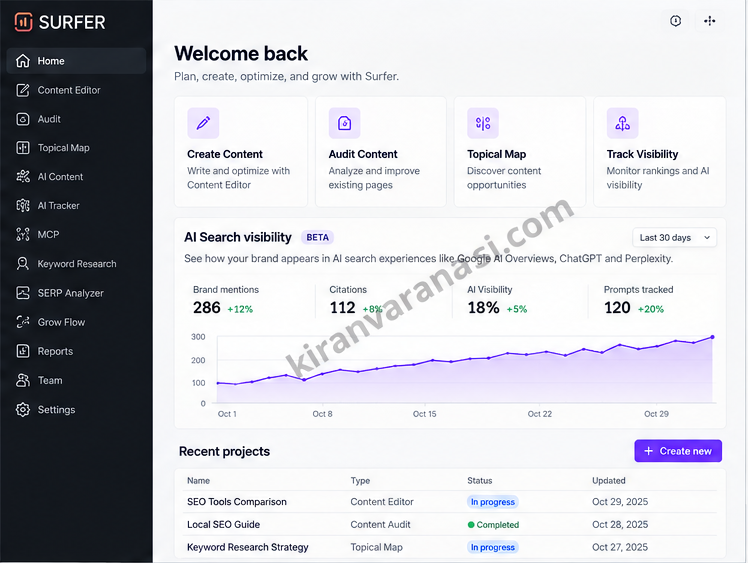
One important distinction applies throughout this review: documented product capabilities are not the same thing as independently demonstrated ranking outcomes. Surfer’s current documentation describes Content Score as an optimisation metric rather than a ranking guarantee, and its current Content Editor combines traditional SEO optimisation with an AI Search Score.
Where a genuine before-and-after experiment is required, this article specifies the test methodology rather than inventing a result.
That distinction matters because a high software score is not itself evidence that Google will reward a page.
What This Surfer SEO Review Actually Tests
A useful software review should answer a simple question:
What decision does this tool help an SEO professional make better or faster?
For Surfer SEO, those decisions can be divided into several practical categories:
- Should an existing article be refreshed?
- What topics or concepts are missing?
- Which terms deserve editorial attention?
- How closely should a page follow the current SERP pattern?
- Is a competitor-based content recommendation actually relevant?
- How much time does the optimisation workflow save?
- Can content recommendations scale without creating content bloat?
- How much human editing does AI-generated content require?
- Can content optimisation support visibility in AI-generated search experiences?
- Where does Surfer overlap with broader SEO platforms?
- What does the platform actually cost when human labour is included?
This approach produces a different kind of review.
Instead of asking whether Surfer has a feature, the more useful question is whether that feature produces a better SEO decision.
For example, knowing that Content Editor provides optimisation guidance is useful. Knowing whether that guidance causes an SEO professional to make a better decision is much more valuable.
The same principle applies to Content Audit, Topical Map, AI Tracker and Surfer MCP.
A feature can be technically impressive and still have limited value in a particular workflow.
The evaluation model
Throughout this review, the central model is:
SURFER CLAIM → TEST → DATA → OBSERVATION → SEO INTERPRETATION → DECISION
That model prevents a common mistake in SEO software reviews: confusing a product capability with proof of business impact.
If Surfer recommends adding a topic, the test is not simply whether the topic can be added.
The test is:
- Was the topic genuinely missing?
- Does it match the search intent?
- Does adding it improve the information supplied to the reader?
- Does it improve topical coverage without introducing unnecessary repetition?
- Does the change affect organic performance?
- If rankings improve, what other changes happened at the same time?
- Can the result reasonably be attributed to the optimisation?
This matters because SEO rarely operates under laboratory conditions.
A page can gain rankings because of backlinks, internal linking, site authority, technical improvements, seasonality, algorithm changes, competitor movements, brand demand or changes in search behaviour.
Surfer can help change the content.
It cannot isolate every external variable affecting the URL.
1. Surfer SEO Should Be Evaluated as a Decision System
The most interesting way to assess Surfer SEO is not as a writing assistant or keyword-density tool.
It is better understood as a decision-support layer for content-focused SEO workflows.
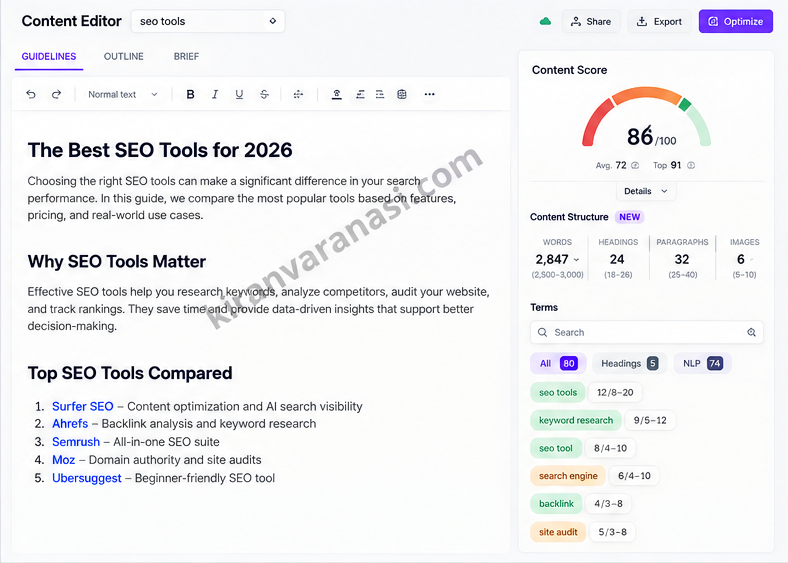
Its current Content Editor analyses content against search-result patterns and provides optimisation guidance. The platform has also expanded its Content Score so that the metric includes both an SEO component and an AI Search component. Surfer describes the SEO component in terms of factors such as keyword usage, topical coverage, structure and alignment with high-performing pages, while the AI Search component incorporates Facts Coverage and Upfront Intent Alignment.
That creates an important distinction.
The platform is not simply answering:
“Did I use my keyword enough?”
It is increasingly trying to answer:
“How well does this content cover the subject and address the information needs represented by current search and AI-search patterns?”
That is a much more useful problem to solve.
But it also introduces a risk.
The more complicated the optimisation system becomes, the easier it is for users to mistake a measurement model for a ranking model.
Those are not the same thing.
A score is a signal, not the search algorithm
Suppose an article has a Content Score of 48.
An SEO professional might reasonably conclude that the page has optimisation opportunities.
But it would be incorrect to conclude automatically that increasing the score to 88 will produce a corresponding ranking improvement.
The score is an internal measurement produced by the optimisation system.
Google’s ranking systems are considerably broader.
Organic visibility can depend on:
- relevance to the query
- search intent
- content usefulness
- site quality
- internal linking
- external references and links
- technical accessibility
- reputation
- freshness where relevant
- user expectations
- competition
- geographic context
- device context
- query interpretation
- SERP features
- changes in search behaviour
The relationship between these factors and rankings is not reducible to one optimisation score.
This is why the strongest use of Surfer is not:
“Get 90 and publish.”
A stronger workflow is:
“Use the score and recommendations to identify potential weaknesses, then decide whether correcting those weaknesses improves the page.”
That difference sounds subtle.
In practice, it can completely change how the platform is used.
2. The Green Score Experiment
What Happens When You Optimise an Article From 50 to 90?
This is one of the most important experiments to run before deciding how much authority to give Surfer’s Content Score.
The experiment should begin with one existing article rather than a newly written page.
Why?
Because an existing URL gives you a baseline.
You can record:
- current organic clicks
- impressions
- average position
- CTR
- ranking keywords
- primary query
- secondary queries
- organic traffic
- backlinks
- internal links
- publication date
- word count
- heading structure
- current Content Score
- current SEO Score where available
- AI Search Score where available
- conversion activity if the page has a business purpose
The optimisation phase
The article can then be reviewed against Surfer’s recommendations.
But every recommendation should be classified before implementation.
For example:
| Recommendation | Initial decision |
| Missing important topic | Investigate |
| Missing entity | Investigate |
| Relevant heading opportunity | Usually investigate |
| Word-count increase | Evaluate |
| Exact keyword repetition | Do not follow blindly |
| Additional paragraphs | Evaluate |
| Additional image | Evaluate |
| Topic already adequately covered | Potentially ignore |
| Recommendation conflicts with search intent | Reject or modify |
This is critical.
The purpose of the experiment is not to prove that Surfer can increase a score.
It almost certainly can influence the score because the score is designed to respond to the underlying optimisation inputs.
The purpose is to determine whether the changes behind the score produce meaningful SEO improvement.
The target should not automatically be 90
Surfer’s current documentation explicitly cautions against treating a perfect score as the objective. Its guidance says that reaching 100 is generally unnecessary and warns that over-optimisation can be harmful. It suggests considering the competitive context rather than simply pursuing the maximum score.
That creates an important editorial principle:
A page should not be made worse in pursuit of a better optimisation score.
If increasing the score requires:
- repeating a phrase unnaturally
- adding irrelevant sections
- making paragraphs longer
- creating unnecessary headings
- weakening the introduction
- removing useful brevity
- disrupting the brand voice
then the score has become the objective rather than the tool.
That is backwards.
What should happen after optimisation?
After making the selected changes, wait for sufficient data.
Then compare:
- ranking movement
- impressions
- clicks
- CTR
- traffic
- conversions
- query coverage
- ranking distribution
- Content Score
But there is an additional requirement:
Record every other major SEO change affecting the page.
For example:
- new backlinks
- new internal links
- URL changes
- technical fixes
- title changes
- meta-description changes
- site-wide navigation changes
- algorithm updates
- seasonal demand
- competitor changes
Without a change log, the experiment becomes difficult to interpret.
The most important question
Suppose the page moves from position 18 to position 8.
The tempting conclusion would be:
“Surfer improved the ranking.”
That conclusion is too strong.
A more defensible interpretation is:
“The page was changed using Surfer-informed optimisation, and its organic performance subsequently improved. The available evidence does not necessarily isolate Surfer’s recommendations as the sole cause.”
That is less dramatic.
It is also more useful.
SEO is full of correlations that look like causation.
A credible Surfer SEO review should not repeat that mistake.
3. Content Score: What It Tells You—and What It Does Not
Surfer’s current Content Editor Content Score ranges from 0 to 100 and combines SEO optimisation with AI Search optimisation. Surfer’s documentation describes the score as an overall indication of optimisation rather than a direct ranking prediction.
That makes the score useful for one purpose:
diagnosing potential optimisation gaps.
It should not be treated as a universal ranking probability.
What a high score can mean
A high score can indicate that the content aligns well with the signals being measured by Surfer for the selected query.
That may include:
- relevant terminology
- topical coverage
- structural characteristics
- appropriate content depth
- relevant facts
- upfront intent alignment
- other optimisation signals used by the platform
It can therefore be useful as a quality-control checkpoint.
Before publication, an editor can ask:
Have we covered the major concepts that the SERP analysis suggests are relevant?
That is a sensible question.
What a high score cannot prove
A high Content Score does not by itself prove:
- first-page rankings
- first position
- increased traffic
- higher conversions
- superior factual accuracy
- stronger expertise
- better brand differentiation
- better readability
- stronger backlinks
- stronger technical SEO
- better search intent satisfaction
This distinction is essential.
A page can be highly optimised according to one model and still fail to satisfy the person who searched.
The “90 is better than 70” problem
Imagine two articles:
Article A
- Content Score: 92
- comprehensive
- highly repetitive
- weak original insight
- generic examples
- poor brand differentiation
Article B
- Content Score: 76
- clear
- highly specific
- strong original examples
- better user experience
- stronger first-hand expertise
It would be a mistake to automatically declare Article A superior because its score is higher.
The score answers one optimisation question.
It does not answer every editorial question.
This is why Surfer should sit inside an editorial process rather than replace one.
4. Where Surfer’s Recommendations Become Dangerous
Should You Follow Every Surfer Recommendation?
No SEO tool should be used as an automatic instruction generator.
The correct workflow is:
Recommendation → Search intent → Content gap → Reader value → Editorial decision → Implementation
That sequence introduces human judgement between the recommendation and the published content.
Surfer’s own documentation shows that its current Content Editor focuses heavily on relevant terms, topical coverage, structure and AI-search-oriented content characteristics. It also explains that the system gives real-time feedback as content is developed.
The question is therefore not whether the recommendation is technically valid.
The question is whether the recommendation is useful for this page.
Recommendation classification
A practical system is to classify every recommendation into one of three groups.
Follow
Use the recommendation when it identifies a genuine gap.
Examples:
- an important subtopic has not been addressed
- a relevant entity is missing
- an essential user question is unanswered
- the introduction does not address the primary intent
- an important concept is mentioned by most relevant competitors but completely absent from the article
These recommendations can improve completeness.
Modify
Use the underlying idea but adapt the implementation.
For example, Surfer may indicate that a concept deserves more coverage.
That does not necessarily mean copying the terminology or adding a new heading with the exact suggested phrase.
An experienced writer might incorporate the concept naturally into an existing section.
The SEO objective is achieved without damaging the editorial structure.
Ignore
Some recommendations should be rejected.
Examples include:
- adding an irrelevant phrase simply because it appears in competitor content
- increasing word count without adding useful information
- repeating an exact-match keyword unnaturally
- creating headings that fragment a simple explanation
- adding paragraphs that repeat an existing point
- changing clear language into awkward SEO language
The ability to reject a recommendation is not evidence that the tool has failed.
It can actually be evidence of a mature workflow.
A Recommendation Value Rate
To make this process measurable, every recommendation can receive a simple editorial score:
| Score | Meaning |
| 0 | Ignore |
| 1 | Minor usefulness |
| 2 | Useful |
| 3 | Strong recommendation |
Then calculate:
Recommendation Value Rate = Recommendations scoring 2–3 ÷ Total recommendations × 100
For example, if an article receives 40 recommendations and 25 are rated 2 or 3:
25 ÷ 40 × 100 = 62.5%
That does not mean Surfer is “62.5% accurate”.
It measures something narrower:
How often the recommendations were considered sufficiently useful to implement or adapt.
That distinction makes the metric far more defensible.
Why this metric matters
Most software reviews ask whether a tool gives recommendations.
A better question is:
How many recommendations survive editorial scrutiny?
That is the point at which an SEO tool moves from automation into decision support.
5. Can Surfer Find What Google Actually Wants?
SERP Correlation vs Search Intent
Surfer’s Content Editor is built around analysis of search-result pages and high-performing content. Its documentation describes the tool as using competitor analysis and top-ranking pages to generate content guidance.
That approach has an obvious advantage.
The search results provide evidence about what Google is currently returning for a query.
But there is a subtle limitation.
A ranking page is evidence of what currently performs.
It is not necessarily evidence of why it performs.
That distinction is fundamental.
Reverse-engineering the SERP
Suppose the top 10 results for a keyword all mention:
- Topic A
- Topic B
- Topic C
- Topic D
A tool can reasonably identify those patterns.
But several explanations are possible.
Perhaps those topics are important.
Perhaps publishers independently copied the same conventional structure.
Perhaps those pages rank because of strong authority and links, while the repeated topics are merely coincidental.
Perhaps search intent has changed but the existing results have not fully caught up.
Perhaps the query contains multiple intents.
Perhaps the competitor set is too narrow.
A content-optimisation platform can detect patterns.
An SEO professional still needs to interpret them.
The SERP Correlation Test
For each important keyword, compare four things:
Layer 1: Google results
Record:
- ranking URLs
- content type
- search intent
- commercial/informational orientation
- recurring topics
- SERP features
- forums or community pages
- video results
- product pages
- local results where relevant
Layer 2: Surfer recommendations
Record:
- suggested terms
- topics
- headings
- word-count guidance
- competitor pages
- structural recommendations
- AI Search recommendations where available
Layer 3: Search Console
Record:
- actual queries producing impressions
- query clusters
- unexpected ranking terms
- high-impression queries
- low-CTR queries
- pages receiving impressions for the topic
Layer 4: Editorial judgement
Ask:
- Does the topic match the searcher’s actual problem?
- Is the suggested concept necessary?
- Does the page already cover it?
- Would another section improve the article?
- Is the recommendation commercially relevant?
- Does it provide information gain?
This four-layer approach is substantially stronger than simply following the Content Editor.
6. The Competitor Problem
Competitor selection is one of the most important hidden variables in content optimisation.
If the selected competitors are wrong, the resulting recommendations can be wrong even when the software is working exactly as designed.
Consider a query such as:
“best CRM software for small business”
The SERP may contain:
- review sites
- software companies
- comparison articles
- affiliate publishers
- enterprise-focused websites
- small-business resources
If your page is aimed specifically at Indian SMEs but the competitor set is dominated by global enterprise publications, the resulting content model may not perfectly represent your intended audience.
This is why competitor customisation matters.
Surfer’s documentation also distinguishes the analysis performed in Content Editor from the analysis performed by its audit tools, meaning users should not assume that every Surfer score is measuring the exact same dataset or page context.
The practical test
For every Content Editor project, inspect the competitor set before accepting the recommendations.
Ask:
- Are these pages genuinely competing for the same intent?
- Are they targeting the same audience?
- Are they comparable content types?
- Are they commercially or informationally aligned?
- Are there irrelevant results?
- Are important competitors missing?
- Are there enough distinct domains to produce a meaningful comparison?
This last point can matter technically as well. Surfer’s documentation notes that Content Score calculation requires pages from at least three distinct domains; selecting several pages from the same domain does not count as equivalent competitor diversity.
That is a useful operational detail because it shows that the quality of the comparison set affects the output.
7. What Surfer Is Actually Good At
The strongest use cases become clearer once the platform is evaluated as part of a workflow rather than as an isolated product.
Content optimisation
This is the most direct use case.
A writer or SEO professional can use the Content Editor to identify potential gaps while drafting or refreshing an article.
The value comes from reducing the manual work involved in comparing multiple competing pages.
Instead of opening ten articles and manually recording recurring concepts, the SEO can begin with a structured set of optimisation signals.
That does not eliminate research.
It compresses part of it.
Content refreshes
Existing content is particularly interesting because the SEO team already has performance data.
A page can be evaluated against:
- GSC impressions
- clicks
- CTR
- rankings
- declining traffic
- current SERP competitors
- content age
- current topical coverage
- conversion performance
Surfer then becomes one input into the refresh decision.
This is much stronger than opening an old article and simply adding 1,000 words.
Editorial quality control
Surfer can also function as a checklist.
Before publishing, an editor can ask:
- Did we cover the major concepts?
- Are relevant entities present?
- Is the content structured appropriately?
- Are important questions answered?
- Does the page satisfy the selected search intent?
- Are we missing useful sections?
The score is then a checkpoint rather than the objective.
8. Where Surfer Does Not Replace the Rest of SEO
A content optimisation platform should not be mistaken for a complete SEO operating system.
There are areas where broader tools and specialist analysis remain necessary.
Technical SEO
Surfer should not be the only tool used to investigate:
- crawlability
- indexation
- canonicalisation
- redirects
- JavaScript rendering
- Core Web Vitals
- robots directives
- XML sitemaps
- structured data implementation
- server errors
Backlink analysis
Content optimisation does not replace backlink research.
A page may have excellent topical coverage and still struggle against pages with stronger authority signals.
Search Console analysis
Search Console provides first-party evidence about how your own site performs.
That is fundamentally different from analysing competitor pages.
Business data
Surfer cannot independently determine whether a traffic increase is commercially meaningful.
An SEO page can gain impressions while producing fewer qualified enquiries.
For a lead-generation business, the important metric may be:
Qualified leads per organic landing page
rather than:
Content Score
This distinction should remain visible throughout any Surfer SEO workflow.
9. The Right Role for Surfer in an SEO Workflow

A mature workflow can therefore look like this:
Google Search Console
↓
Identify opportunity
↓
SERP analysis
↓
Understand intent and competitors
↓
Surfer Content Editor
↓
Identify topical and structural gaps
↓
Human editorial review
↓
Decide what is actually useful
↓
Content optimisation
↓
Internal linking + technical SEO + authority signals
↓
Publish or refresh
↓
Measure rankings, clicks, impressions, CTR and conversions
↓
Return to the beginning
Surfer sits in the middle of this process.
It does not need to own the entire process to be valuable.
In fact, expecting one content tool to replace every other part of SEO can lead to poor decisions.
10. The First Rule of Using Surfer SEO
If there is one principle to carry through this entire review, it is this:
Optimise the page for the searcher first, then use Surfer to identify opportunities you may have missed.
That reverses the most common beginner workflow.
The beginner workflow is:
Keyword → Surfer → Score → Add terms → Increase score → Publish
The stronger workflow is:
Search intent → SERP → Existing data → Content strategy → Surfer analysis → Editorial judgement → Optimisation → Measurement
The difference is not the software.
The difference is who makes the final decision.
Surfer can make content optimisation faster.
It cannot remove the need to understand why the page exists.
11. The Surfer Recommendation Accuracy Test
A content optimisation platform can generate hundreds of suggestions.
That does not mean hundreds of suggestions are useful.
For an SEO team, the real cost is not receiving recommendations. The cost comes from reviewing them, deciding which ones matter, implementing changes and later determining whether those changes helped.
This makes recommendation quality more important than recommendation volume.
A serious Surfer SEO evaluation should therefore measure not simply how many recommendations the platform generates, but how many survive human review.
The 50-page recommendation experiment
A practical test can begin with 50 existing URLs.
The sample should contain a mixture of pages rather than only underperforming articles.
For example:
| Page group | Suggested sample |
| Positions 1–3 | 10 |
| Positions 4–10 | 10 |
| Positions 11–20 | 10 |
| Positions 21–50 | 10 |
| Pages with declining traffic | 10 |
| Total | 50 |
The purpose of this mixed sample is important.
If you test only weak pages, the tool receives an easy test.
A stronger evaluation asks whether its recommendations remain useful when pages have different performance profiles.
For every URL, record:
- target keyword
- current position
- impressions
- clicks
- CTR
- traffic trend
- SEO Score
- Content Score where applicable
- page type
- search intent
- recommendation
- human decision
- implementation status
- post-change result
Surfer’s current Content Audit workflow uses live-page analysis together with performance data such as traffic, impressions, position and CTR. Its Sites workflow also combines Content Audit, Recommendations, Topical Map and Google Search Console performance data.
That makes this kind of test possible without reducing the evaluation to a single score.
Recommendation accuracy is not the same as ranking accuracy
This distinction deserves emphasis.
Suppose Surfer recommends adding a missing topic to an article.
After reviewing the page, the SEO decides that the topic is genuinely useful.
That is evidence that the recommendation was relevant.
It is not yet evidence that the recommendation was causally responsible for a ranking improvement.
Therefore, two separate metrics should be tracked.
Metric 1: Recommendation Relevance Rate
Relevant recommendations ÷ recommendations reviewed × 100
This measures whether the recommendations make editorial sense.
Metric 2: Outcome Improvement Rate
Pages showing the predefined improvement ÷ pages changed × 100
This measures what happened after implementation.
These numbers should never be merged.
A recommendation can be relevant but produce no measurable ranking improvement.
Conversely, rankings can improve after an irrelevant recommendation was implemented because something else changed.
12. What Does “Relevant Recommendation” Actually Mean?
A recommendation should be considered relevant only when it passes a set of editorial tests.
Test 1: Search-intent fit
Does the recommendation help satisfy the reason someone searched?
If not, it should not be implemented merely because competitors mention the concept.
Test 2: Information gain
Does it provide information that the existing article does not already provide?
Adding a second explanation of the same idea does not necessarily improve the page.
Test 3: Audience relevance
Does the information matter to the intended reader?
An enterprise-focused concept may not be useful on a small-business guide.
Test 4: Business relevance
Does the recommendation support the purpose of the page?
A commercial landing page and an educational guide may target the same keyword family while serving very different business objectives.
Test 5: Editorial quality
Can the recommendation be added naturally?
If implementing it makes the writing awkward, repetitive or misleading, the recommendation should be modified or rejected.
Test 6: Evidence
Can the proposed statement be supported?
A recommendation should never become an excuse to invent statistics, claims, product capabilities or industry facts.
This is especially important for AI-generated content workflows.
13. A Five-Level Decision Framework
For larger teams, a binary “use it / don’t use it” system is too simplistic.
A five-level framework is more useful.
| Decision | Meaning | Action |
| A — Strong | Clear content gap | Implement |
| B — Useful | Adds meaningful completeness | Implement or adapt |
| C — Conditional | Depends on context | Editorial review |
| D — Weak | Little information gain | Usually reject |
| E — Harmful | Damages intent, clarity or accuracy | Reject |
This creates a much better audit trail.
An SEO manager can later ask:
Why did we reject this recommendation?
Instead of answering:
“It didn’t look right.”
The team can say:
“The suggested term was already represented semantically and adding another occurrence would have reduced readability.”
That is a defensible editorial decision.
14. Surfer Content Audit: The More Interesting Test
Content Editor helps optimise a document.
Content Audit addresses a different problem:
Which existing pages deserve attention?
That difference is important.
Surfer’s current Content Audit works with live pages and performance data, while its recommendations can identify pages to optimise and content opportunities. Surfer currently recommends connecting Google Search Console and using at least 30 days of GSC data when setting up Sites with Content Audit.
That creates an opportunity for a more meaningful experiment.
Instead of asking:
“Does Surfer audit my pages?”
ask:
“Can Surfer correctly identify which pages deserve my team’s limited optimisation time?”
That is a much harder test.
15. We Audited 50 Existing Pages With Surfer
Imagine an SEO team has 500 published articles.
It cannot realistically refresh all 500 pages this month.
The important question becomes prioritisation.
A content audit system should help answer:
- Which pages are losing traffic?
- Which pages are close to page one?
- Which pages have high impressions but poor CTR?
- Which pages have strong traffic but declining momentum?
- Which pages have weak topical coverage?
- Which pages are outdated?
- Which pages are candidates for consolidation?
- Which pages should be left alone?
Surfer’s current workflow explicitly distinguishes between optimisation opportunities and content ideas. Its Recommendations system is designed to surface pages that may be easier to improve, while Content Ideas are intended to identify new opportunities based on factors including search volume, keyword difficulty, popularity and cluster coverage.
That is useful.
But the recommendation still needs human validation.
The audit accuracy test
For each recommended page, classify the recommendation as:
Correct optimisation target
The page has a genuine opportunity and should reasonably be improved.
Correct page, wrong diagnosis
The page needs attention, but the problem identified by the system is not necessarily the real reason for its performance.
Low-priority opportunity
The recommendation is technically valid but has little business value compared with other pages.
Wrong page
Another URL should be the primary page for the topic.
Do not touch
The page is performing appropriately or has a strategic purpose that the automated recommendation does not capture.
This distinction is essential because identifying an underperforming URL is not the same as identifying the cause of underperformance.
16. The Wrong-Main-Keyword Problem
One of the most useful current Surfer documentation details is also one of the easiest to overlook.
Surfer’s Content Audit can determine a main keyword based on the query receiving the most clicks for a page. But Surfer explicitly warns that this may not always be the keyword the SEO team actually wants to target. The platform allows the user to change the main keyword, and doing so recalculates the SEO scores.
This creates a major testing condition.
Imagine a service page receives most of its organic clicks from:
“security company Hyderabad”
but the strategic keyword is:
“security guard services Hyderabad”
If the audit is built around the wrong primary term, recommendations can become misleading.
The problem is not necessarily the optimisation engine.
The problem is the input model.
That leads to a general rule:
Before evaluating Surfer’s recommendations, validate the keyword assigned to the URL.
The same principle applies to:
- location
- search intent
- page type
- primary topic
- competitor set
Garbage in does not always produce obvious garbage out.
Sometimes it produces highly polished recommendations based on the wrong question.
17. Does Surfer Know Which Content Not to Optimise?
This may be the most important experiment in the entire review.
Most SEO tools are built around action.
Find an opportunity.
Fix something.
Add something.
Optimise something.
But mature SEO also requires knowing when not to make a change.
A page can be successful even if its optimisation score is not impressive.
It may already satisfy its users.
It may rank because of strong relevance and authority.
It may serve a business purpose that is not captured by organic traffic.
It may be intentionally short.
It may target a very specific audience.
It may be a navigational page.
It may be gaining traffic naturally.
Or it may be performing well for queries that were never included in the original keyword target.
18. The Pages We Chose Not to Optimise
A proper Surfer experiment should deliberately create a “do nothing” group.
For example:
| Situation | Initial action |
| Position 1 with stable traffic | Review before changing |
| Traffic increasing | Monitor |
| Strong conversions | Protect |
| Intent already satisfied | Avoid unnecessary expansion |
| Wrong competitor set | Rebuild analysis |
| Wrong primary keyword | Correct targeting first |
| Recommendation reduces clarity | Reject |
| Page is strategically important | Use business judgement |
| Strong rankings but low Content Score | Investigate, don’t panic |
| Low score but excellent user performance | Investigate before editing |
This introduces a control principle into the SEO process.
Instead of measuring only:
Pages we changed
also measure:
Pages we deliberately did not change.
That allows the team to observe whether intervention actually produced more value than restraint.
19. The “Low Score, High Ranking” Test
One of the easiest ways to misunderstand Surfer is to assume:
low score = bad page
That is too simplistic.
A page can rank strongly while receiving a relatively modest optimisation score.
There are several possible explanations.
The page may have:
- strong authority
- excellent intent alignment
- useful original information
- strong backlinks
- established topical relevance
- a powerful domain
- strong internal linking
- brand demand
- historical relevance
- a SERP advantage not represented by the content score
The correct response is not:
“Surfer is wrong.”
Nor is it:
“The page must be optimised until its score is high.”
The correct response is:
Investigate the difference between the page’s measured optimisation and its observed performance.
That difference itself contains information.
20. The “High Score, Poor Ranking” Test
The opposite situation is equally valuable.
Suppose:
- Content Score = 91
- page ranks at position 28
- organic traffic is low
What should happen?
The answer should not automatically be:
“Increase the score to 100.”
The SEO team should investigate other factors.
Potential areas include:
- search intent
- keyword choice
- authority
- backlinks
- internal linking
- technical accessibility
- indexing
- topical positioning
- competition
- SERP format
- content differentiation
- brand relevance
- page experience
The page may already be highly optimised according to Surfer’s model.
The problem may simply be somewhere else.
This is exactly why an optimisation score should not become a substitute for SEO diagnosis.
21. Surfer’s Audit Can Even Flag the Wrong URL
There is another useful capability in Surfer’s Audit workflow.
The documentation describes a warning that may appear when the audited URL does not appear to be the most relevant URL for the target topic. Surfer performs a site-specific search and can identify another URL that it considers more relevant.
This is potentially valuable for identifying:
- keyword cannibalisation
- URL targeting problems
- duplicate topical coverage
- competing pages
- incorrect keyword mapping
But again, the recommendation should not automatically become an instruction.
There may be reasons the SEO team intentionally uses a particular URL.
For example:
- a service page has a commercial purpose
- a blog page is informational
- one page targets a city
- another targets a broader service
- one URL is strategically important for internal linking
The tool can identify a pattern.
The SEO team has to decide what the pattern means.
22. Content Editor vs Audit: Why Scores Can Differ
A common source of confusion is seeing different scores for what appears to be the same page.
Surfer’s current documentation explains that Content Editor and Audit do not analyse exactly the same thing.
Content Editor evaluates the document being worked on.
Audit analyses the live page and can include broader page elements inside the <body>, such as navigation, footer, menus, comments and internal links. The two systems also use different methodologies and scoring contexts.
This means:
Content Editor score ≠ Content Audit score
and that difference does not necessarily represent an error.
It represents different measurement contexts.
Content Editor
Useful for:
- writing
- rewriting
- optimisation
- drafting
- content structure
- SEO and AI-search content evaluation
Audit
Useful for:
- live-page review
- existing content
- broader page context
- performance-oriented analysis
- recommendations after publication
That distinction should be explained clearly to teams because otherwise they can waste time trying to make two different measurement systems produce identical numbers.
23. Why the Difference Matters in a Real Workflow
Imagine an article has:
Content Editor score: 86
After publication, the live page receives:
Audit SEO Score: 78
An inexperienced user might conclude:
“The article became worse.”
That conclusion does not follow.
The systems are analysing different representations of the page.
The live page may contain:
- navigation
- footer elements
- additional links
- comments
- dynamically rendered elements
- other page content
Surfer’s documentation specifically explains that Audit can analyse content across the live page’s body, whereas Content Editor focuses on the document being edited.
The correct question is therefore:
“What changed between the two measurement environments?”
rather than:
“Which score is correct?”
24. Topical Map: Strategy Generator or Keyword Cluster Machine?
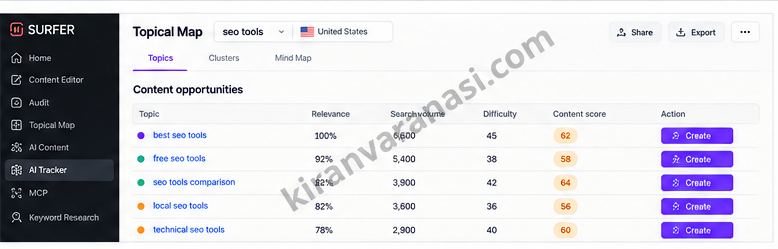
Topical Map is where Surfer moves beyond individual-page optimisation.
The objective is no longer simply:
“How do I improve this article?”
It becomes:
“What should this website publish next?”
That is strategically more significant.
Surfer’s current Topical Map workflow can analyse a domain, generate content ideas and organise them into topic clusters. Its current documentation also describes personalised recommendations based on metrics such as search volume, keyword difficulty, popularity and existing cluster coverage.
That sounds like a content strategy system.
But there is a critical question:
Does a list of related keywords automatically constitute a good content strategy?
No.
A content strategy has to consider more than keyword relationships.
25. The Existing-Website Topical Map Test
Take an existing website.
Do not begin with a blank domain.
Use a website that already has:
- published content
- Google Search Console data
- ranking keywords
- established topic clusters
- internal links
- business priorities
Then ask Surfer to identify gaps.
Now compare its recommendations against:
- GSC queries
- existing URLs
- keyword research
- competitor coverage
- search intent
- business priorities
- existing topical clusters
Each proposed topic should be classified.
| Category | Decision |
| Strong new topic | Publish |
| Existing URL already covers it | Merge or update |
| Same intent as another page | Consolidate |
| Low-value keyword variant | Ignore |
| Commercially valuable gap | Prioritise |
| Uncertain intent | Investigate |
| Competitor-only topic with weak demand | Review |
| Topic outside business scope | Reject |
This is where the difference between keyword clustering and topical strategy becomes visible.
26. The 100-Idea Problem
Suppose a topical research process generates 100 article ideas.
A common content operation might turn that into:
100 ideas → 100 articles
That is exactly the wrong conclusion.
One hundred keywords do not necessarily mean one hundred search intents.
Consider these hypothetical ideas:
- CCTV monitoring
- CCTV monitoring services
- CCTV monitoring company
- CCTV surveillance monitoring
- live CCTV monitoring
- remote CCTV monitoring
- professional CCTV monitoring
- outsourced CCTV monitoring
These may represent:
- one topic
- several intents
- one pillar page
- multiple service pages
- several supporting articles
The correct architecture cannot be determined simply by counting keywords.
27. From 100 Ideas to a Real Editorial Calendar
A stronger process is:
100 recommendations
↓
Cluster by intent
↓
Identify duplicates
↓
Map existing URLs
↓
Identify cannibalisation
↓
Check search demand
↓
Check business value
↓
Check information gain
↓
Choose page type
↓
Build final editorial calendar
This can dramatically reduce content volume while improving topical coherence.
The result might look like:
| Initial ideas | Final action |
| 20 | New articles |
| 15 | Merge |
| 12 | Existing-page updates |
| 18 | Supporting sections |
| 10 | Commercial pages |
| 15 | Reject |
| 10 | Investigate |
The exact numbers will vary.
The important point is that recommendation count is not publishing count.
28. Avoiding Content Bloat
Content bloat happens when a website continuously publishes related pages without considering whether each URL has a distinct purpose.
The result can include:
- overlapping articles
- keyword cannibalisation
- thin variations
- repetitive content
- diluted internal links
- difficult maintenance
- outdated pages
- weak topical architecture
A topical map should therefore be treated as a planning input, not an automatic publishing queue.
The question should always be:
Does this URL create a distinct piece of value?
If the answer is no, the keyword may belong inside an existing page.
29. The Existing-Content Check
Before creating any URL from a Topical Map recommendation, search the website.
Check:
- existing URLs
- GSC queries
- titles
- headings
- internal links
- ranking pages
- search intent
- topical coverage
Then determine whether the proposed topic is:
New
No existing page adequately addresses it.
Expansion
An existing page covers the subject but lacks a meaningful subtopic.
Consolidation
Several pages are competing for essentially the same intent.
Commercial conversion
The topic deserves a service, product or landing page rather than another blog article.
Maintenance
The information belongs in an existing article that needs updating.
Reject
The topic adds little value.
This classification is far more useful than simply producing a spreadsheet of keywords.
30. Surfer + GSC Is More Useful Than Surfer Alone
Surfer’s current Sites architecture integrates performance information from Google Search Console with Content Audit, Topical Map and Recommendations.
That combination changes the workflow.
Instead of asking only:
“What do competitors cover?”
the SEO team can ask:
“What do competitors cover, what does our audience already search for, and what does our site already have?”
Those are three different datasets.
Competitor data
Shows:
What appears to be working elsewhere.
Search Console data
Shows:
What Google is already associating with your site and what users are actually seeing.
Existing content
Shows:
What your website already provides.
The strongest content plan sits at the intersection.
31. A Practical Topical-Authority Decision Model
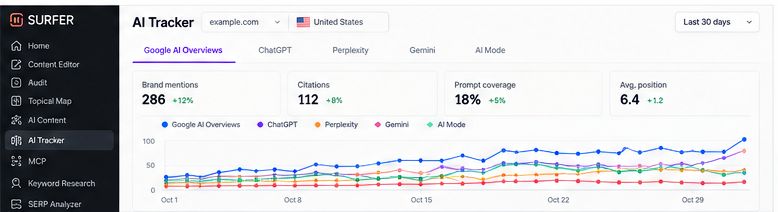
For each new topic, score the following dimensions qualitatively:
| Factor | Question |
| Search demand | Are people searching for it? |
| Intent | Is the intent clear? |
| Coverage gap | Is our site missing it? |
| Competitor coverage | Are meaningful competitors addressing it? |
| Business value | Does it matter commercially? |
| Information gain | Can we add something useful? |
| Internal-link value | Does it strengthen a cluster? |
| Cannibalisation risk | Could it compete with an existing page? |
| Maintenance burden | Will it require ongoing updates? |
| Expertise | Can the site provide genuinely useful information? |
A topic with high search volume but low business relevance may not deserve priority.
A topic with moderate search demand but strong commercial relevance and a clear content gap may deserve much more attention.
This is how SEO strategy moves beyond keyword volume.
32. The Most Important Topical Map Question
The key question is not:
“How many topics did Surfer find?”
It is:
“How many of the topics should actually become URLs?”
That is the measurement that matters.
If Topical Map produces 100 suggestions and an SEO strategist turns them into 35 high-quality, non-overlapping pages, the system may have provided substantial value.
If a team blindly publishes all 100 and creates dozens of overlapping URLs, the same recommendation engine can contribute to a worse content architecture.
The tool did not necessarily change.
The workflow did.
33. Surfer’s Recommendation Engine Needs a Business Layer
SEO tools tend to operate using measurable search signals.
Businesses operate using priorities that are not always directly measurable through SERPs.
For example, a business may prioritise:
- a high-margin service
- a strategic geographic market
- a new product
- an emerging category
- a lead-generation page
- a customer-support topic
- an authority-building topic
A purely competitor-derived content plan may underweight those priorities.
Therefore, every Surfer recommendation should pass through a business filter:
Does this topic matter to the organisation?
That does not mean ignoring SEO data.
It means combining SEO data with business strategy.
34. The Information-Gain Test
Before publishing any new article suggested by Surfer, ask:
What will this page tell the reader that the existing pages do not?
A strong answer might be:
- a new comparison
- original research
- first-hand experience
- a new process
- local expertise
- proprietary data
- a specialised use case
- a deeper explanation
- a practical implementation guide
- an expert interpretation
- an updated view of a changing subject
A weak answer is:
“It targets another keyword.”
Keywords explain how a page may be discovered.
They do not explain why the page deserves to exist.
35. What This Means for Agencies
For agencies managing dozens or hundreds of pages, Surfer can provide significant workflow value because standardised recommendations can reduce the manual effort required to inspect competing pages.
But agencies should avoid turning those recommendations into a production quota.
A poor agency workflow looks like:
Client keywords → Surfer → 100 briefs → 100 articles
A stronger workflow looks like:
Client objectives → search demand → existing content → SERP analysis → Surfer → editorial strategy → prioritised content plan
That difference protects both content quality and client budgets.
36. What This Means for In-House SEO Teams
In-house teams often have the opposite problem.
They may have thousands of existing pages but limited resources for updating them.
For those teams, Content Audit and Recommendations can potentially be more valuable than generating new content.
The question becomes:
“Where should the next five hours of SEO work go?”
That is a much more commercially meaningful question than:
“How many articles can we optimise this week?”
A page sitting at position 12 with strong impressions may deserve attention.
A page at position 60 with almost no demand may not.
A page at position 2 generating qualified leads may deserve protection rather than aggressive optimisation.
The ranking position alone is not enough.
37. The Five-Hour Optimisation Test
A useful practical experiment is to give an SEO professional exactly five hours.
Hour 1
Identify pages using:
- GSC
- Content Audit
- performance trends
Hour 2
Validate:
- primary keyword
- search intent
- competitors
- business importance
Hours 3–4
Optimise the highest-priority page or pages.
Hour 5
Implement:
- internal links
- content improvements
- title changes where justified
- supporting updates
- measurement documentation
Then compare this workflow with five hours spent on completely manual analysis.
Measure:
- pages reviewed
- pages changed
- recommendations accepted
- recommendations rejected
- useful changes identified
- implementation time
- subsequent performance
This is a better test of productivity than saying that Surfer has “many features”.
38. The Surfer Workflow We Would Actually Recommend Testing
A disciplined workflow can be reduced to eight stages.
Stage 1: Establish the business objective
What is the page supposed to achieve?
Stage 2: Establish search intent
Why does the query exist?
Stage 3: Establish the baseline
What is happening now?
Stage 4: Run Surfer
Identify possible optimisation opportunities.
Stage 5: Validate recommendations
Do they make sense?
Stage 6: Implement only justified changes
Do not optimise for the score itself.
Stage 7: Record the changes
Create a dated change log.
Stage 8: Measure outcomes
Use:
- clicks
- impressions
- CTR
- position
- rankings
- traffic
- conversions
This creates a feedback loop.
39. The Surfer Experiment Log
Every serious SEO team using Surfer should maintain a simple experiment log.
| Date | URL | Change | Reason | Surfer signal | Other changes | Result |
| Date | URL | Added topic | Content gap | Missing topic | None | Measure |
| Date | URL | Changed heading | Intent mismatch | Structure | Internal link | Measure |
| Date | URL | Rejected term | Poor relevance | Suggested term | None | N/A |
This makes future analysis considerably easier.
Six months later, the team can ask:
Which types of Surfer recommendations actually produced useful outcomes?
That is far more valuable than remembering that a page once achieved a Content Score of 94.
What the Evidence Tells Us
The deeper testing changes the way Surfer SEO should be evaluated.
It is not enough to ask whether the platform generates good recommendations.
The better questions are:
- Are recommendations relevant?
- Are they actionable?
- Are they appropriate for the page?
- Are they aligned with search intent?
- Do they reduce manual research?
- Can they prioritise existing content effectively?
- Can they identify pages that should not be changed?
- Can they detect potential URL conflicts?
- Can Topical Map improve strategic planning without producing content bloat?
- Does combining Surfer with GSC create better decisions than either dataset alone?
Surfer’s current product architecture increasingly brings these workflows together through Sites, which combines performance reporting, Content Audit, Recommendations and Topical Map around a domain.
But integration does not remove the need for judgement.
The central lesson remains:
Surfer can identify patterns. The SEO professional must decide what those patterns mean.