
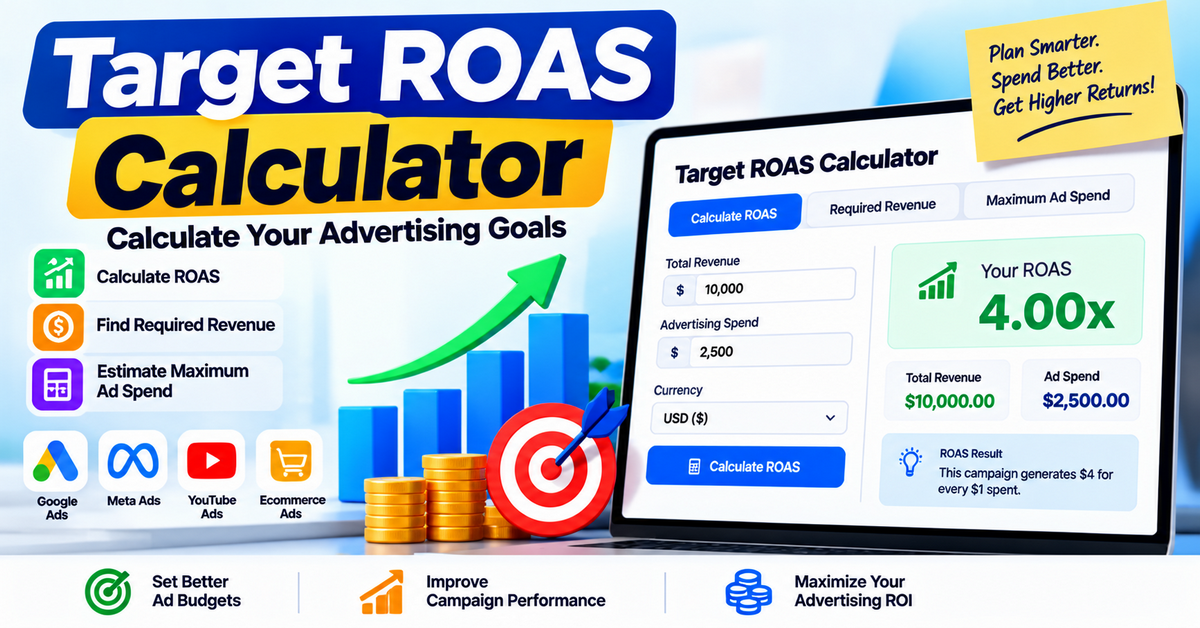
Setting the right advertising budget is important for running profitable paid marketing campaigns. A Target ROAS Calculator helps you determine the return you need from your advertising spend, calculate required revenue, and estimate the maximum amount you can spend while maintaining a specific target ROAS.
Whether you run Google Ads, Meta Ads, ecommerce campaigns, or other performance marketing campaigns, understanding ROAS can help you evaluate advertising efficiency and set measurable revenue targets.
Target ROAS Calculator
Calculate your return on ad spend, required revenue, or maximum advertising budget based on your target ROAS.
Calculation Results
Use the Target ROAS Calculator below to calculate your current ROAS, required revenue for a target ROAS, or maximum advertising spend based on your expected revenue.
[Insert the Target ROAS Calculator tool here]
What Is a Target ROAS Calculator?
A Target ROAS Calculator is an online tool that helps advertisers calculate and plan their return on ad spend.
ROAS stands for Return on Ad Spend. It measures how much revenue a campaign generates for every unit of currency spent on advertising.
For example, if you spend $1,000 on advertising and generate $4,000 in revenue, your ROAS is:
$4,000 ÷ $1,000 = 4x ROAS
A 4x ROAS means the campaign generated $4 in revenue for every $1 spent on advertising.
The calculator can work in three ways:
- Calculate your actual ROAS from revenue and advertising spend.
- Calculate the revenue required to achieve a target ROAS.
- Calculate the maximum advertising budget based on expected revenue and target ROAS.
How to Use the Target ROAS Calculator
The calculator provides three different calculation modes depending on what you want to determine.
Calculate ROAS
Choose Calculate ROAS when you already know your advertising spend and the revenue generated from your campaign.
Enter:
- Total revenue
- Advertising spend
- Currency
The calculator then determines your ROAS.
For example:
- Revenue: $10,000
- Advertising spend: $2,500
The calculation is:
ROAS = $10,000 ÷ $2,500 = 4x
Calculate Required Revenue
Choose Required Revenue when you have an advertising budget and want to know how much revenue you need to reach a specific ROAS target.
Enter:
- Advertising spend
- Target ROAS
- Currency
For example, if your advertising budget is $2,500 and your target ROAS is 4x:
Required Revenue = $2,500 × 4 = $10,000
You would need $10,000 in revenue to achieve a 4x ROAS.
Calculate Maximum Ad Spend
Choose Maximum Ad Spend when you have an expected revenue target and want to determine how much you can spend while maintaining your desired ROAS.
Enter:
- Expected revenue
- Target ROAS
- Currency
For example, if you expect $20,000 in revenue and want a 5x ROAS:
Maximum Ad Spend = $20,000 ÷ 5 = $4,000
This means $4,000 is the maximum advertising spend represented by that target-revenue and target-ROAS calculation.
What Is ROAS?
ROAS, or Return on Ad Spend, is a marketing metric used to measure the revenue generated by advertising relative to advertising costs.
The basic ROAS formula is:
ROAS = Revenue ÷ Advertising Spend
For example:
| Revenue | Ad Spend | ROAS |
|---|---|---|
| $5,000 | $1,000 | 5x |
| $10,000 | $2,500 | 4x |
| $20,000 | $5,000 | 4x |
| $30,000 | $10,000 | 3x |
A higher ROAS means more revenue was generated relative to the advertising spend. However, ROAS alone does not show the complete profitability of a business because it does not account for product costs, fulfillment, salaries, software, taxes, agency fees, and other expenses.
What Is Target ROAS?
Target ROAS is the return on ad spend that you want an advertising campaign to achieve.
For example, a business might set a target of:
- 2x ROAS
- 3x ROAS
- 4x ROAS
- 5x ROAS
- 6x ROAS
A target of 4x means you want to generate $4 in revenue for every $1 spent on advertising.
Your target ROAS should be considered alongside your profit margins and other business costs.
Target ROAS Formula
There are three important formulas used by the Target ROAS Calculator.
ROAS Formula
ROAS = Revenue ÷ Advertising Spend
Example:
Revenue = $12,000
Ad spend = $3,000
ROAS = $12,000 ÷ $3,000 = 4x
Required Revenue Formula
If you know your advertising budget and desired ROAS:
Required Revenue = Advertising Spend × Target ROAS
Example:
Ad spend = $5,000
Target ROAS = 4x
Required Revenue = $5,000 × 4 = $20,000
Maximum Ad Spend Formula
If you know your expected revenue and target ROAS:
Maximum Ad Spend = Expected Revenue ÷ Target ROAS
Example:
Expected revenue = $30,000
Target ROAS = 5x
Maximum Ad Spend = $30,000 ÷ 5 = $6,000
How to Calculate Your Target ROAS
Your target ROAS should be based on the economics of your business rather than choosing a number arbitrarily.
One useful starting point is your break-even ROAS.
If you spend $1 on advertising and your business retains $0.25 of revenue after variable costs, you would need a higher ROAS to cover that advertising expense and reach profitability.
For example, if your contribution margin is 25%, the simplified break-even ROAS would be:
1 ÷ 0.25 = 4x
This illustrates why two businesses selling different products can require very different ROAS targets.
Your actual target should also consider other costs and the specific way your business measures profit.
What Is a Good Target ROAS?
There is no universal ROAS target that is appropriate for every business.
A suitable target can vary depending on:
- Profit margins
- Product costs
- Customer acquisition costs
- Average order value
- Repeat purchases
- Customer lifetime value
- Fulfillment costs
- Advertising platform
- Campaign objective
- Business model
For example, an ecommerce business with strong repeat-purchase behavior may evaluate advertising performance differently from a business that relies entirely on one-time purchases.
Instead of comparing your ROAS with an arbitrary benchmark, consider whether the resulting customer acquisition economics work for your business.
Target ROAS vs Actual ROAS
Target ROAS is the return you want your campaign to achieve.
Actual ROAS is the return your campaign actually generates.
For example:
- Target ROAS: 4x
- Actual ROAS: 3.5x
The campaign generated less revenue per advertising dollar than the target.
If:
- Target ROAS: 4x
- Actual ROAS: 5x
The campaign generated more revenue per advertising dollar than the target.
Tracking both metrics helps you compare your advertising objective with actual campaign performance.
How to Improve ROAS
If your actual ROAS is below your target, there are several areas you can investigate.
Improve Ad Targeting
Review your audience targeting and identify segments that generate stronger conversion rates or higher-value customers.
Improve Ad Creative
Test different headlines, images, videos, offers, calls to action, and messaging to identify combinations that produce better results.
Improve Landing Pages
A high-quality landing page can make it easier for visitors to understand the offer and complete the desired action.
Review:
- Page speed
- Mobile usability
- Headlines
- Product information
- Calls to action
- Trust signals
- Checkout experience
Increase Conversion Rate
Improving your conversion rate can increase revenue without requiring the same proportional increase in advertising spend.
Increase Average Order Value
Bundles, upsells, cross-sells, and other offers can increase revenue per customer and potentially improve campaign economics.
Review Low-Performing Campaigns
Identify campaigns, audiences, keywords, products, or creatives that consume advertising budget without generating sufficient revenue.
Target ROAS for Ecommerce
Target ROAS is particularly useful for ecommerce businesses because advertising spend can be directly compared with online sales revenue.
For example, an ecommerce store may have:
- Average order value: $100
- Advertising spend: $5,000
- Revenue: $20,000
The ROAS would be:
$20,000 ÷ $5,000 = 4x
However, a 4x ROAS does not automatically mean the campaign is profitable. Product costs, shipping, payment processing, returns, discounts, and other expenses also affect profitability.
Target ROAS for Google Ads
Target ROAS is commonly associated with conversion-value-based advertising campaigns, particularly ecommerce and lead-generation campaigns where conversion values can be assigned.
Advertisers can use a target ROAS approach to establish a desired relationship between advertising spend and conversion value.
The appropriate target depends on your margins, conversion values, campaign history, and business objectives.
The calculator can help you understand the basic financial relationship before setting or changing campaign targets.
Target ROAS for Facebook and Instagram Ads
Meta advertising campaigns can also be evaluated using ROAS when you track purchase or conversion values.
For example, if a Meta campaign spends $2,000 and generates $8,000 in tracked purchase revenue:
ROAS = $8,000 ÷ $2,000 = 4x
You can then compare the actual result with your target ROAS.
Remember that attribution settings, reporting windows, tracking configuration, and platform-specific measurement can affect the revenue figures used in your calculation.
Target ROAS and Profitability
ROAS and profitability are related but they are not the same thing.
Consider a product that sells for $100.
If the business spends $25 on advertising to generate that sale, the advertising ROAS based on revenue is:
$100 ÷ $25 = 4x
But the business still has to pay for:
- Product costs
- Shipping
- Payment processing
- Returns
- Discounts
- Employees
- Software
- Taxes
- Other operating expenses
Therefore, use ROAS as one part of your advertising analysis rather than treating it as a complete measure of business profit.
Target ROAS Calculator for Marketing Agencies
Marketing agencies can use a Target ROAS Calculator to help clients understand advertising budgets and revenue requirements.
For example, an agency could calculate:
- Expected revenue from a proposed ad budget
- Required revenue for a target ROAS
- Maximum spend based on a revenue target
- Actual ROAS from campaign results
This can make budget planning easier when discussing performance marketing campaigns with clients.
Target ROAS Calculator for Small Businesses
Small businesses can use the calculator to test different advertising scenarios before committing a large budget.
For example, suppose you have a $1,000 advertising budget and want a 3x ROAS.
The required revenue would be:
$1,000 × 3 = $3,000
You can then evaluate whether generating $3,000 in revenue from that advertising budget is realistic based on your historical campaign data.
Why Use a Target ROAS Calculator?
A Target ROAS Calculator can simplify several common advertising calculations.
Instead of manually calculating each scenario, you can quickly determine:
- Current ROAS
- Required revenue
- Maximum advertising spend
- Revenue needed for a specific target
- Advertising budget based on expected revenue
It can also help marketers compare different budget scenarios when planning campaigns.
Target ROAS Calculator Example
Let's consider a simple campaign.
Suppose you spend:
$4,000 on advertising
And generate:
$16,000 in revenue
Your ROAS is:
$16,000 ÷ $4,000 = 4x
Now suppose you want to maintain a 4x target ROAS and plan to spend $6,000.
Your required revenue would be:
$6,000 × 4 = $24,000
Therefore, a $6,000 advertising budget would require $24,000 in revenue to achieve a 4x ROAS.
Frequently Asked Questions About Target ROAS
What is a Target ROAS Calculator?
A Target ROAS Calculator is a tool that helps you calculate return on ad spend, determine the revenue required to reach a target ROAS, or estimate the maximum advertising budget based on expected revenue.
How do I calculate ROAS?
Calculate ROAS by dividing revenue generated from advertising by the amount spent on advertising.
ROAS = Revenue ÷ Advertising Spend
For example, $10,000 in revenue from $2,000 in ad spend equals a 5x ROAS.
What does a 4x ROAS mean?
A 4x ROAS means your campaign generated $4 in tracked revenue for every $1 spent on advertising.
How do I calculate required revenue for a target ROAS?
Multiply your advertising spend by your target ROAS.
Required Revenue = Advertising Spend × Target ROAS
For example, $5,000 in ad spend at a 4x target requires $20,000 in revenue.
How do I calculate maximum ad spend?
Divide your expected revenue by your target ROAS.
Maximum Ad Spend = Expected Revenue ÷ Target ROAS
For example, $20,000 in expected revenue at a 4x target ROAS gives a maximum calculated ad spend of $5,000.
Is a higher ROAS always better?
A higher ROAS means more revenue was generated relative to advertising spend, but it does not automatically mean higher overall profit. Product costs, operating expenses, customer lifetime value, and other factors also matter.
What is a good target ROAS?
There is no single target ROAS that works for every business. Your target should be based on factors such as margins, customer acquisition costs, average order value, repeat purchases, and overall profitability.
Can I use this calculator for ecommerce?
Yes. You can use the Target ROAS Calculator to calculate ecommerce advertising ROAS, required revenue, and maximum ad spend based on your target.
Final Thoughts
A Target ROAS Calculator makes it easier to understand the relationship between advertising spend, revenue, and your desired return on ad spend.
You can use it to calculate your current ROAS, determine how much revenue you need to achieve a specific target, or estimate the maximum advertising budget supported by an expected revenue target.
Remember that ROAS is only one part of campaign performance. For a more complete view of advertising profitability, consider product margins, customer acquisition costs, operating expenses, repeat purchases, and customer lifetime value alongside your ROAS.
Use the calculator above to test different advertising scenarios and make your campaign budget calculations faster and easier.